🔥 Featured Questions
Satya Nadella's $96.5M Pay Raise After 15,000+ Microsoft Layoffs: AI Success Story or Broken Trust With Workers?

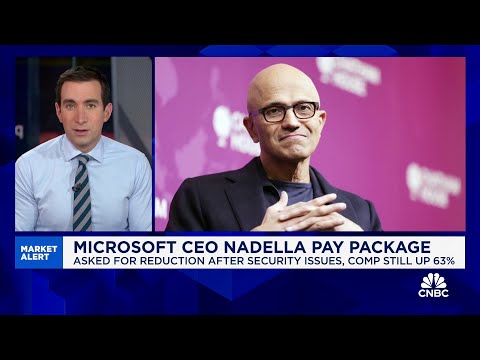
In a July 2025 internal memo, Microsoft CEO Satya Nadella told employees that the year's layoffs, which ultimately cut more than 15,000 jobs across gaming, security, and management, were "weighing heavily on me," calling the contradiction between record profits and mass cuts the "enigma of success." Months later, proxy filings showed Nadella's fiscal 2025 compensation climbed 22% to a record $96.5 million ($2.5M salary, roughly $9.5M cash bonus, about $84M in stock awards), tied to metrics including Azure and cloud revenue growth as Microsoft's cloud business hit roughly $169 billion (up 23%) and Azure topped $75 billion (up 34%). Former Microsoft HR vice president Chris Williams called it an "accountability issue," saying the optics of a massive CEO pay raise while thousands of employees lose their jobs undermines trust, while Microsoft noted that 10,000 laid-off employees cost roughly $1 billion annually, far more than trimming Nadella's pay could offset. As of today, financial outlets are still revisiting the pay-versus-layoffs math even as Nadella pushes an AI-driven "smarter, leaner" workforce vision, with Microsoft's CEO-to-median-worker pay ratio now near 480-to-1.

A 22% raise to $96.5 million in the same year Microsoft cut more than 15,000 jobs sends a corrosive message about whose sacrifice funds whose reward. Critics like former HR VP Chris Williams argue the optics alone, a nearly 480-to-1 CEO-to-worker pay ratio, expose a governance system that rewards leadership even as rank-and-file employees absorb the cost of the AI transition.
Nadella's pay is performance-based and tied directly to the metrics that matter: total shareholder return, and the Azure/cloud growth that powered Microsoft's AI transformation (34% Azure growth, ~$169B cloud revenue). Layoffs, while painful, are a rational cost of that AI pivot, and rewarding the executive who delivered those results is standard governance, not a scandal.
Both things can be true at once: Nadella's memo language about layoffs "weighing heavily" on him may be sincere, and his pay may be contractually earned, yet the gap between that heartfelt memo and a record payday months later points to a leadership communication problem more than a moral one. The real debate may be whether Microsoft's AI-era compensation structure itself needs reform.

Poll as Guest Infographics
From around the web

Similar to hewsay's "Satya Nadella's $96.5M Pay Raise After 15,000+ Microsoft Layoffs: AI Success Story or Broken Trust With Workers?"

Quoted & linked with attribution — not a hewsay user post.
What is the difference between Bill Gates' Microsoft and Satya Nadella's Microsoft? How has Microsoft changed under Satya Nadella? All this economic surge possible to Microsoft not only because Satya Nadella took over as CEO but also the foundation laid by Bill Gates and Steve...
quora.com · Quora
View original
What was wrong with Microsoft before Satya Nadella joined the company? How has Microsoft changed under Satya Nadella? All this economic surge possible to Microsoft not only because Satya Nadella took over as CEO but also the foundation laid by Bill Gates and Steve Ballmer. How...
quora.com · Quora
View original
The $13.9 Million F.P. Journe Résonance: Proof Independent Watchmaking Has Conquered Horology, or a Speculative Bubble in the Making?

On June 13, 2026, Phillips' New York Watch Auction XIV sold an F.P. Journe Chronomètre à Résonance "Souscription" No. 007 (dated 2000) for $13,922,000, instantly making it the most expensive F.P. Journe ever sold and the most expensive watch by any independent watchmaker ever sold at auction. The piece was one of just 20 "Souscription" watches Journe delivered to the earliest patrons who prepaid to bankroll his tiny atelier in the late 1990s, and this was its first-ever appearance at public auction. The sale anchored a record-shattering $75.8 million two-day total, with all 158 lots selling (100% sell-through) and 16 lots crossing the $1 million mark, making it the highest-grossing watch auction in U.S. history. It capped a historic spring 2026 season for Phillips in which independent watchmakers like Journe repeatedly out-priced storied Swiss maisons such as Patek Philippe and Audemars Piguet. Supporters frame it as vindication: a self-taught, independent watchmaker who once needed subscription financing now sits atop the entire auction market. Skeptics counter that a $13.9 million watch is less a horological verdict than a symptom of scarcity-driven mania among ultra-wealthy collectors, raising the question of whether this reflects genuine artisanal value or a bubble inflated by hype and provenance storytelling.


🗳️ 10 votes so far🏆 Leading: This sale is the ultimate vindication of independent watchmaking as an art form, not just a fashion trend. François-Paul Journe started with nothing but a workbench and a dream, financing his earliest watches through subscription payments from believers willing to bet on his talent before he had a brand name behind him. That a self-made artisan-watchmaker now outranks entire centuries-old maisons like Patek Philippe and Audemars Piguet at auction proves that true horological mastery and authentic craftsmanship ultimately triumph over marketing budgets and brand heritage alone. Collectors aren't paying for a logo; they're paying for a documented piece of horological history and the story of a genius who bet on himself. This is the watch world finally rewarding substance over spectacle, and it should be celebrated as such. (40%)🥈 Strip away the romantic narrative and this sale is really a story about wealth concentration and the financialization of luxury goods, not horology. A watch is fundamentally a device that tells time, the fact that a small circle of billionaires and family offices are now paying eight figures for one says more about where surplus global capital is flowing than about Journe's undeniable mechanical skill. Auction houses like Phillips have strong financial incentives to hype records every season since their fees scale directly with hammer prices, turning watch auctions into a self-reinforcing marketing machine for an increasingly narrow, ultra-wealthy buyer pool. Meanwhile everyday enthusiasts and even loyal Journe collectors get priced further out of a hobby that once prized accessible artisanship, as pieces become trophy assets stored in vaults rather than worn and enjoyed. Celebrating this sale as a horological triumph ignores the uncomfortable truth that it primarily signals inequality and speculative capital allocation, not a democratization or validation of craft. (40%)🥉 A $13.9 million wristwatch is not a rational valuation of engineering, it's a textbook speculative bubble dressed up in horological jargon. Phillips just posted its second record-breaking U.S. auction total in six months, selling every single one of 158 lots and pushing 16 watches past $1 million, a sell-through rate that looks far more like a hype cycle than a stable collectibles market. The pattern mirrors past manias, from vintage Rolex in 2021-2022 to contemporary art, where scarcity narratives and a handful of ultra-wealthy bidders chasing bragging rights inflate prices detached from any use value or historical precedent. When one auction house can shatter a brand's previous record in a single sale, that's not price discovery, it's momentum trading with hairsprings instead of tickers. History suggests these speculative peaks eventually correct, and buyers chasing headline records today may be the ones left holding depreciating investments tomorrow. (20%)⚖️ Split decision🌍 🇨🇳 China, 🇲🇩 Moldova
This sale is the ultimate vindication of independent watchmaking as an art form, not just a fashion trend. François-Paul Journe started with nothing but a workbench and a dream, financing his earliest watches through subscription payments from believers willing to bet on his talent before he had a brand name behind him. That a self-made artisan-watchmaker now outranks entire centuries-old maisons like Patek Philippe and Audemars Piguet at auction proves that true horological mastery and authentic craftsmanship ultimately triumph over marketing budgets and brand heritage alone. Collectors aren't paying for a logo; they're paying for a documented piece of horological history and the story of a genius who bet on himself. This is the watch world finally rewarding substance over spectacle, and it should be celebrated as such.
Strip away the romantic narrative and this sale is really a story about wealth concentration and the financialization of luxury goods, not horology. A watch is fundamentally a device that tells time, the fact that a small circle of billionaires and family offices are now paying eight figures for one says more about where surplus global capital is flowing than about Journe's undeniable mechanical skill. Auction houses like Phillips have strong financial incentives to hype records every season since their fees scale directly with hammer prices, turning watch auctions into a self-reinforcing marketing machine for an increasingly narrow, ultra-wealthy buyer pool. Meanwhile everyday enthusiasts and even loyal Journe collectors get priced further out of a hobby that once prized accessible artisanship, as pieces become trophy assets stored in vaults rather than worn and enjoyed. Celebrating this sale as a horological triumph ignores the uncomfortable truth that it primarily signals inequality and speculative capital allocation, not a democratization or validation of craft.
A $13.9 million wristwatch is not a rational valuation of engineering, it's a textbook speculative bubble dressed up in horological jargon. Phillips just posted its second record-breaking U.S. auction total in six months, selling every single one of 158 lots and pushing 16 watches past $1 million, a sell-through rate that looks far more like a hype cycle than a stable collectibles market. The pattern mirrors past manias, from vintage Rolex in 2021-2022 to contemporary art, where scarcity narratives and a handful of ultra-wealthy bidders chasing bragging rights inflate prices detached from any use value or historical precedent. When one auction house can shatter a brand's previous record in a single sale, that's not price discovery, it's momentum trading with hairsprings instead of tickers. History suggests these speculative peaks eventually correct, and buyers chasing headline records today may be the ones left holding depreciating investments tomorrow.

Poll as Guest Infographics
From around the web

Similar to hewsay's "The $13.9 Million F.P. Journe Résonance: Proof Independent Watchmaking Has Conquered Horology, or a Speculative Bubble in the Making?"

Quoted & linked with attribution — not a hewsay user post.
What skills are needed to learn horology (watch making)? What is the difference between horology and watchmaking (watches)? The field of horology fascinates me and I am genuinely interested in learning about watches, from basic stuff like different types of watch movements to ...
quora.com · Quora
View original
I have always been obsessed with watches and watchmaking. What should I buy for me to start my journey into watchmaking? Then you can start your career either with your own neighbourhood workshop, try to get a job with a watch company, or use your. Then you can start your care...
quora.com · Quora
View original

Never miss a new question

One email per question, straight to your inbox. Unsubscribe anytime.